Within the demanding arena of today's professional sliding, victory is far more than purely a function of brute torque or behind-the-wheel bravado. Instead, it has become a complex discipline which necessitates a meticulous marriage of selecting a time-tested vehicle platform, equipping it with the highest-quality competition hardware, and, most importantly, comprehending its dynamic characteristics on the course through cutting-edge suspension tuning applications. This definitive manual will serve as your roadmap starting from the initial concept of a competition vehicle all the way to the last engineering-refined tweaks that elevate a strong machine into a consistent podium finisher. We will thoroughly explore the precise engineering of vehicle alignment optimization, demonstrating how a modern suspension tuning tool like precise measurement hardware eliminates assumptions and delivers unparalleled clarity into your car's actual dynamics.
The foundation of any exceptional drift machine is, undoubtedly, the platform itself. Certain vehicles have attained renowned standing within the worldwide oversteer community due to their natural balance, robust build quality, and the immense ecosystem of specialist support available. Choosing the right starting point is the initial and most significant decision a builder will make. As an example, the the E36 generation BMW is widely regarded as perhaps the the greatest all-around drift cars of history. Its near-perfect balanced front-to-rear weight, alongside a driven rear axle setup and extremely reliable inline-six motors, forms a car that is simultaneously accessible for beginners and highly effective in the hands of a pro competitor. The successor of this concept, the BMW E46 platform, improves on these strengths with a increasingly refined frame, broader stance for improved high-speed stability, and even a greater degree of lock straight from the manufacturer. Another dominant option in the top-level scene is the Corvette C6.
This American performance car offers a unique set of advantages to the sliding sport, including a low-mass alloy chassis, a transaxle-style gearbox and differential unit that aids in an ideal weight distribution, and the tremendous torque of a large-displacement LS-series V8 engine. This fusion makes it an absolute force on track, able of entering and holding long slides with relatively minimal use of acceleration. For builders desiring exceptional performance per dollar, the Nissan 350Z rises above as a excellent example. It is delivered from the factory with a rigid body structure, a effective OEM locking differential, and the responsive VQ series powerplant that delivers plenty of performance for mastering and progressing in the discipline. Its successor, the Nissan 370Z, presents additional advancements in body strength, handling precision, and peak powerplant performance, establishing its position as a common selection among competitive competitors. Other iconic platforms that warrant consideration are the nimble Wankel-engined Mazda FC RX-7, the most popular Nissan S13, the American Ford Mustang SN95, the modern BMW E90, and the tiny yet unbelievably fun and teachable MX-5 Miata. All of these platforms gives a different palette of characteristics, difficulties, and capabilities, but they all share the fundamental components essential to become a competitive drift machine.
However, selecting the correct car is just the starting point. To unlock the full potential of every of these machines, substantial modifications to the steering system and damping and springing systems are completely essential. This is where the world of specialist tuning hardware enters sharp focus. The one most game-changing modification for a serious drift car is the integration of a drift-spec steering angle kit. These advanced assemblies, such as those manufactured by industry leaders like specialist manufacturers, are designed to radically increase the vehicle's possible lock-to-lock rotation. A factory road car is severely restricted in how far its front wheels can turn, a design trade-off for daily driving. In oversteer driving, but, maximum steering input is continuously necessary to manage and hold a slide. An steering kit exchanges the OEM uprights, tie rods, and often control arms with pieces that permit the front tires to attain angles in excess of 70 or even 80 degrees, versus a normal stock setting of around 40 to 50 degrees.
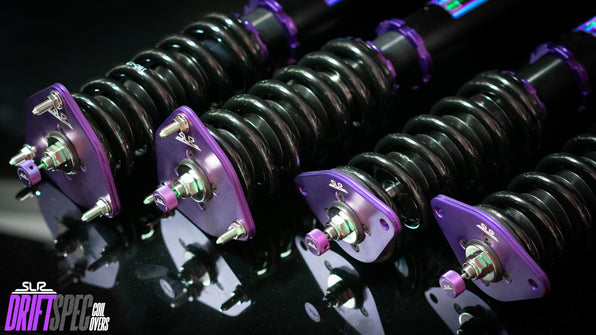
This tremendously increased steering angle gives the driver with significantly enhanced command during a angle, enabling it to be much easier to begin a slide, sustain it through a long bend, and change seamlessly from one angle to the opposite. The improvement in drivability is absolutely transformative. Combined with a properly selected steering kit is the equally vital modification to the car's damping system. Store-bought or even high-end street adjustable suspension are just not designed for the unique and brutal requirements of drifting. A purpose-built pair of coilovers is crucial. These specialized coilovers feature unique damping rates and spring rates that are designed for the extreme weight transfer that is typical of sliding. When a driver initiates a drift, the chassis's inertia is shifted forcefully to the outer of the turn. Optimal drift-spec coilovers handle this shift in a controllable way, allowing the vehicle to find its balance promptly and providing the pilot precise feedback through the wheel and cockpit. They furthermore enable precise adjustment of ground clearance, rebound and compression rate, and cross-weight, which are all key elements of dialing in the chassis's dynamics to a particular track or driving approach. In combination, a top-tier steering angle kit and a expertly chosen pair of performance suspension units constitute the absolute mechanical base upon which all subsequent refinement is constructed.
Once the core components is in place, the following vital step in the development is the precise tuning of the chassis's suspension geometry. This is the realm of vehicle alignment optimization, a methodology that can feel daunting to the beginner but is, in fact, the key to transforming a assembly of fast pieces into a unified and consistent vehicle. The most discussed parameter of suspension geometry for oversteer is undoubtedly negative camber. Camber is the tilt of the rim compared to the upright plane when observed from the forward of the chassis. If the top edge of the tire is leaning towards the chassis, this is referred to as negative camber. For drifting, an inward tilt on the front axle wheels is widely employed and is considered necessary. The purpose is deeply related to physics.
When a car is going around a bend at limit slip angles, the chassis tilts to the external of the corner. This body roll forces the outer front wheel to lose its optimal footprint with the track surface. By adding inward lean, the tire is pre-leaned to compensate for this lean. As the vehicle tilts into the turn, the tire gains a better contact patch against the track, optimizing its traction at the critical moment when it is most required for steering authority. Usually, front angles for a serious drift car vary from approximately -3 degrees to as high as -5 degrees or even beyond, based on the details of the car configuration, tire type, and pilot preference. The rear axle tires also use inward lean, but the angles are typically more modest and less aggressive than the front axle. Excessive camber at the back can result in the chassis excessively loose and difficult to control on throttle input, as it diminishes the usable tire footprint of the powered wheels during linear throttle application. Hence, rear axle angles are often in the vicinity of -1 degree to -3 degrees, finding a delicate equilibrium between offering adequate side traction to assist in starting and holding the drift while still maintaining effective traction for acceleration the bend. camber angle is only one component of the more complex suspension geometry picture, which additionally involves toe setting, caster angle, and suspension-induced steering modification. suspension tuning tool
Toe angle describes the direction of the wheels when viewed from the top. Inward toe means the front edges of the wheels are nearer together than the trailing edges, while negative toe means the opposite. For sliding, a small amount of front axle toe out is often employed to sharpen the initial steering suspension tuning tool response, making the chassis feel more responsive and eager to initiate a drift. Rear toe is typically set to zero or a extremely slight amount of inward toe to foster predictability under power. caster angle is the forward or aft angle of the kingpin axis when observed from the lateral of the car. Positive caster angle enhances self-centering and high-speed confidence, and it also increases negative camber effect during turning, which is very useful. Setting these values is a complex dance where a modification to one setting can and will impact the others. The conventional process for tuning a car's alignment for competition has long been a tedious process of guesswork and adjustment. A tuner or crew would apply a change based on intuition, test the vehicle on track, depend on the operator's subjective perception and impressions, and then apply an additional adjustment. This process would continue over and over until the chassis felt "right" or the allotted track session ended. This approach is not just incredibly wasteful in terms of time and costs, but it is additionally deeply imprecise.
Human perception is a infamously unreliable data source, influenced by numerous variables such as fatigue, evolving track surfaces, weather, and just the mindset of the operator on that specific run. What feels "tail-happy" on one lap might feel "pushing" on the subsequent pass, causing conflicting information and frustrating adjustments. This long-standing limitation in vehicle dynamics optimization is specifically where state-of-the-art telemetry systems has stepped in to transform the methodology.
The development and adoption of sophisticated drift telemetry software has brought about a completely new age for engineering and refining high-performance drift machines. These systems, exemplified by innovative products like modern telemetry hardware, work by actively capturing the real-time mechanical performance of the car as it is operated on the track. Unlike depending on subjective feel, these devices acquire objective information on critical parameters such as shock absorber movement, individual tire rotation, acceleration forces, lock position, and throttle and brake application. This collected data stream is then processed by advanced applications that can visualize and analyze the data in a clear way. For the first time ever, tuners and builders can see specifically what the chassis is doing at any given moment of a lap. This ability transforms the complete suspension tuning workflow. Think about the particular task of setting the front axle camber for a given car. Rather than introducing a modification from -3 degrees to -3.5 degrees and then running several laps to try and "perceive" a change, a telemetry system can provide real-time and clear data. The tool can display graphically how the suspension's contact patch is acting during the critical stages of a slide: initiation, sustain, and transition. It can reveal if the present value is enabling the steering tire to maintain maximum contact or if the tire is over-stressed on its external shoulder.
The tool can subsequently make fact-based recommendations for change. Perhaps the telemetry reveals that the outside front tire is still overworking its edge at -3.5 degrees of negative camber, implying that even more inward lean, say -4 degrees, might be advantageous. vehicle dynamics tool Alternatively, the data might indicate that the tread is not reaching optimal operating temp or that the inside edge is degrading unevenly, which could indicate that there is overly aggressive angle and a modest reduction back to -3.2 degrees would be better optimal. This standard of precision and actionable insight was literally unimaginable in the era of pure seat-of-the-pants adjustment.
The effect of utilizing a comprehensive drift telemetry system reaches far beyond only dialing in camber angles. It becomes an invaluable damper adjustment manual that is customized to your particular car. When fine-tuning the damping clickers on your adjustable dampers, rather than using vague advice or copying another team's setup, you can utilize the telemetry to observe how the vehicle is performing in relation to your changes. The application can display the wheel movement trace over a lap, showing if the shocks are managing the chassis motion optimally or if they are allowing the chassis to become unsettled uncontrollably after a transition. It can help in diagnosing issues like bottoming out or excessive extension, permitting you to introduce educated decisions to preload settings, damping values, or ground clearance. This methodology extends just as well to the detailed process of corner balancing. Beyond camber, the system can give insight into how adjustments to toe settings and caster are impacting the chassis's stability during various parts of a lap. For example, it can assist you to determine the optimal amount of front axle negative toe for your particular angle kit setup and piloting approach by analyzing the response time of initial response and the stability of the chassis at maximum steering angle. This transforms the system an incredibly useful performance optimization handbook that is actively informed by the real-world behavior of your personal vehicle on the circuit. It elevates the whole process from a dark art into a methodical engineering procedure.
Furthermore, the utility of a platform like data acquisition is in no way confined to experienced tuners with vast funding. For the amateur competitor, it acts as an incredible force multiplier. It in essence provides the builder with the knowledge of a professional suspension specialist without requiring the associated overhead. It drastically shortens the tuning process by providing clear answers to problems that would normally take years of trial and error to answer. A builder can understand how their specific car responds to specific settings, building a deeper understanding of vehicle dynamics in the journey. It additionally democratizes high-level performance tuning techniques, permitting every enthusiast with the ambition to refine their vehicle to do so in a structured and effective way. This is notably important in a sport like sliding, where setup knowledge has in the past been a highly secretive advantage among elite crews. In the modern era, that capability can be in the hands of any serious builder.
In conclusion, the process to engineering and tuning the ideal championship-contending sliding vehicle is a multi-stage project that perfectly blends classic engineering wisdom with 21st-century data solutions. It begins with the wise choice of a legendary platform, followed by the installation of non-negotiable competition components like maximum-angle angle modification systems and properly selected drift-spec coilovers. The build then progresses into the detailed phase of alignment optimization, where values like camber angle, toe, and caster are carefully adjusted to suit the car's new capabilities and the operator's personal style. The final step, and what genuinely distinguishes the today's approach from the past, is the use of a sophisticated drift telemetry software. This system eradicates the uncertainty and inefficiency of only seat-of-the-pants tuning by providing objective, live information on how the car is really behaving. It functions as an indispensable engineering partner, a definitive coilover setup manual, and a all-in-one chassis development system. In unison, this complete philosophy ensures that every element of the competition vehicle—from the pick of the car to the last click on the damper—is perfected for peak competitiveness on the track. It embodies the full maturation of the art of oversteer driving, merging mechanical driving skill with surgical chassis dynamics to forge the most competitive cars attainable.